In the peak season, how long does Nikko officially say the jams will be?
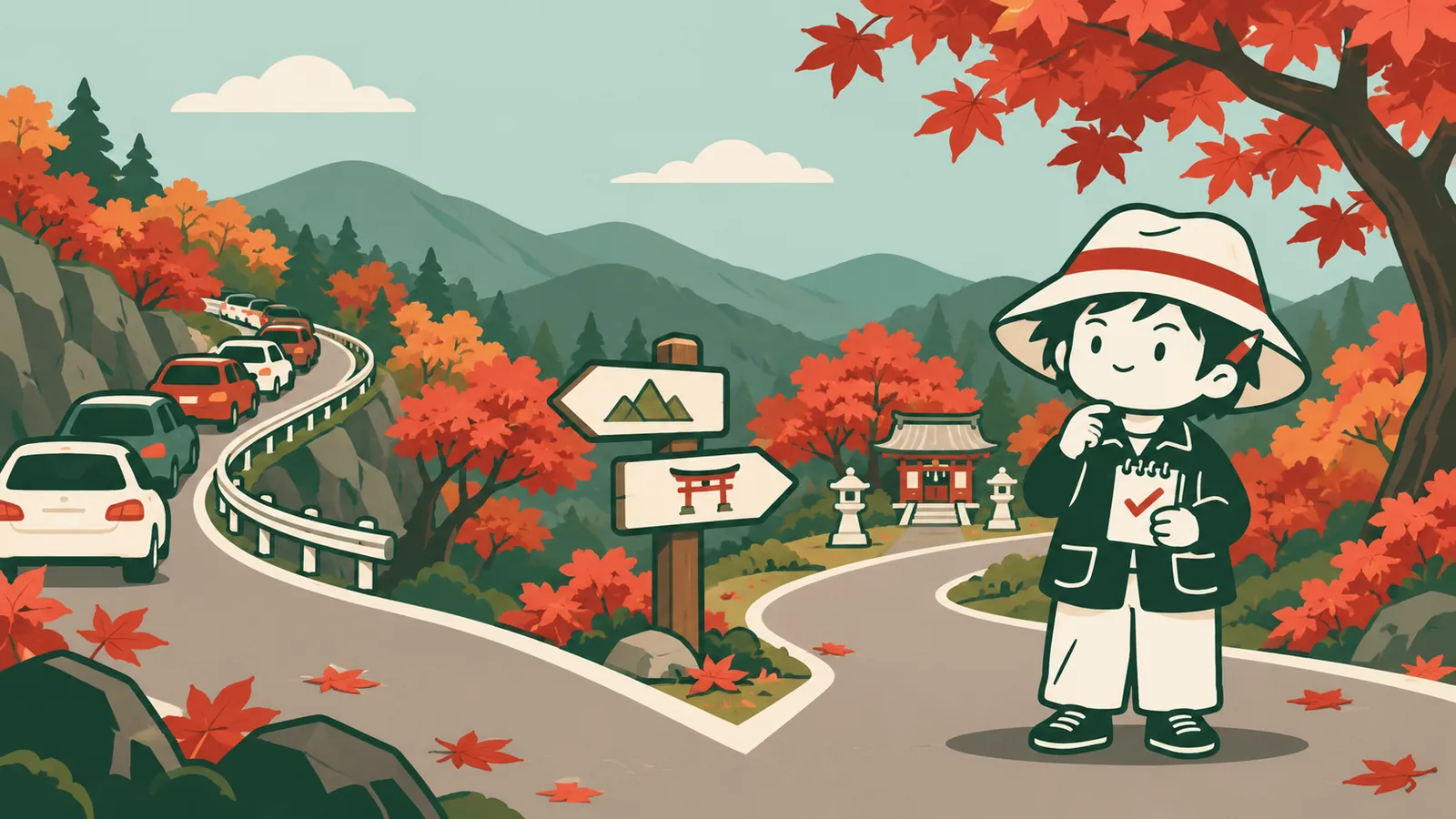
The transport page of the official Nikko tourism site states: in the peak season (mid-October to mid-November) severe traffic jams are expected in Nikko city and on the Irohazaka slope, and from Nikko Station to Lake Chuzenji a normal 45-minute drive may grow to more than 4 hours; for people who want to visit Okunikko, the official site advises staying overnight locally and allowing a lot of extra time. This warning is in the page's car-rental (Rental Cars) section. For buses, a Tochigi Prefecture Transport Policy Division document of 13 February 2026 (route-bus times supplied by Tobu Bus Nikko) gives the second Irohazaka section from Umagaeshi to Chuzenji Onsen as 25 minutes scheduled; on Sunday 2 November 2025 it took 38 minutes around 9:00, 68 minutes around 11:00, 160 minutes around 13:00, 200 minutes around 15:00 and 167 minutes around 17:00.
The Nikko City Tourism Association's traffic jam and congestion information page forecasts "station to the World Heritage area" and "station to Lake Chuzenji" separately and grades them on a calendar (made from past jam records, which may differ from actual conditions, and excluding accidents and broken-down vehicles; updated in September 2026, and updated every 3 months).
Grades of the Nikko City Tourism Association's congestion forecast calendar (checked 2026-11-06)
The table scrolls horizontally. Keyboard users can Tab to the table and use the arrow keys.
| Grade | Station to the World Heritage area | Station to Lake Chuzenji | Source of the rule |
|---|---|---|---|
| Very heavy | 60 minutes or more | 120 minutes or more | Nikko City Tourism Association jam information page |
| Heavy | 30 to 60 minutes | 80 to 120 minutes | Nikko City Tourism Association jam information page |
| Somewhat heavy | 15 to 30 minutes | 60 to 80 minutes | Nikko City Tourism Association jam information page |
| Light | 15 minutes or less | 60 minutes or less | Nikko City Tourism Association jam information page |
This calendar is called the "Traffic Jam Forecast Calendar", and its grades are expressed as minutes needed from the station to that area; the page does not say whether this is by car or by bus. The same page also states that delays of Tobu Bus caused by traffic jams can be checked with the bus's current location. To know which grade your travel day falls in, look at your day's entry in the official calendar PDF; this guide does not read dates for you.
When I can keep only one of the lake and the shrines, which do I decide on first?
If you most look forward to the lake views and mountain colours, make the mountain the main plan and the shrine area a fallback if time allows; if your focus is Toshogu and historic buildings, keep your time for the shrine area. If you want both, first ask yourself: can I stay in Nikko tonight? If not, can I accept completing only one of the two areas?
The official Nikko tips for enjoying foliage while avoiding crowds state: for people who must see the autumn leaves at Irohazaka or Lake Chuzenji, the suggestion is to drive through the jam-prone Irohazaka the day before, stay around Lake Chuzenji or Okunikko Yumoto Onsen, and see them early the next morning; it also states that severe congestion is expected, an early start is the key, and suggests staying several nights in Nikko. All of these involve staying overnight in Nikko, and do not apply to a day trip from Tokyo.
The first decision by situation (checked 2026-11-06)
The table scrolls horizontally. Keyboard users can Tab to the table and use the arrow keys.
| Your situation | The first decision | Official information to note |
|---|---|---|
| The lake is the only must-see, and you can accept cutting sights in town | Make the mountain the main plan, and first confirm the return buses and trains | The official page states Nikko Station to Lake Chuzenji may exceed 4 hours (car-rental section); check the return times first on the Tobu Bus page |
| You must be back in Tokyo that evening for an appointment | First check the return train and the latest acceptable arrival time, then decide the main area | At every calendar grade, the minutes for "station to the World Heritage area" are shorter than for "station to Lake Chuzenji"; the calendar does not say which mode of transport |
| You arrive in Nikko close to noon | Reassess before going up the mountain, and do not reuse the early-arrival version of the plan | Look at the bus current location and current required time on the official jam information page (the page states it is for reference only) |
| You do not want to give up either the lake area or the shrines | Consider adding a night | The official site advises that people who want Okunikko stay overnight locally and allow a lot of extra time |
After choosing the main plan, still watch the on-site transport: on the Tobu Bus Nikko page, on the check date, there were announcements of changes to part of the World Heritage Loop Bus routes and a change of boarding point for the Chuzenji Onsen bus.
Before leaving Tokyo, what should I write down about "what to cut"?
The following is a checking process compiled for this guide, not an official rule. First check that day's return train, the ticket change and refund rules, and the latest acceptable arrival back; then decide the main area in Nikko. Next build two lines: line A has only the main goal; line B is a short plan you can still complete if you do not go up the mountain or finish early.
For example, line A focuses on the Lake Chuzenji area; if you do not go up the mountain, line B can shrink to "Tobu-Nikko Station, Toshogu, back to the station". The Nikko City Tourism Association's Toshogu sight page states: about 10 minutes by World Heritage Loop Bus from Nikko Station or Tobu-Nikko Station, getting off at the "Omotesando" stop and walking about 5 minutes, or getting off at the "Shinkyo" stop and walking about 15 minutes; bus routes may change.
For the opening hours of Toshogu, the same page states 9:00 to 17:00 from April to October (last entry 16:30) and 9:00 to 16:00 from November to March (last entry 15:30); if you arrive after the last entry, you cannot enter that day. The page carries a "barrier-free" tag, but does not state the number of steps or walking distance, so confirm on site according to your companions' condition.
The Tobu Bus Nikko page provides route fares, timetables, boarding points and announcements; the JR Nikko Line boards at stop 1 and the Tobu Nikko Line at stop 2. The English summer timetable's period is marked 1 April 2026 to 30 November 2026. Open this page once more before you leave.
After arriving in Nikko, at which two points do I decide again?
The first is before going up the mountain: the Nikko City Tourism Association's traffic jam and congestion information page provides the Tobu Bus current-location lookup, and the official page states that delays caused by jams can also be checked here, for reference only, so leave slack in the plan. Then ask: after subtracting waiting, going up and down the mountain and the return connection, can you still make the return time you wrote down? If not, switch to line B.
The second is before adding another sight: if you have already seen the main goal and the return information is still unclear, what you are weighing is moving toward the return direction or adding one more sight.
If you have already met congestion on the mountain, check the change rules of your booked return ticket. The Nikko City Tourism Association's traffic page advises drivers to park at a less crowded car park and get around the Toshogu area by bus or on foot; for Lake Chuzenji, it introduces off-peak times and a detour for the Irohazaka slope.
Before departure, which boxes does the trade-off card need filled in?
The Nikko trade-off card needs six boxes filled in before you leave Tokyo: the one must-see, the reason and time you must return, the return train or bus you checked, the basis for going up the mountain, Line B, and the add-on sight to cut first.
- The one must-see today: ____; everything else can be cut.
- The reason and time I must return to Tokyo: ____; if it can change, the cost is ____.
- Return train/bus information I have checked: ____; date checked: ____.
- After arriving in Nikko, the basis for deciding whether to go up the mountain: the official jam information page, operating information, return slack.
- Line B if I do not go up the mountain: ____; opening hours and amount of walking confirmed: yes / no.
- The add-on sight to cut first: ____.
Write the target return time as your own plan; after arriving in Nikko, use that day's operating information to decide whether to go up the mountain.
Where do I look up the last train back to Tokyo?
This guide did not check the last return trains. For bus times, see the Tobu Bus Nikko page; for train times back to Tokyo, check the official timetable of the operator of the train you will take, and confirm again on the day of departure. If you enter and leave through Narita on this trip, for the airport journey see Narita Airport to Shinjuku.
Frequently asked questions
How do I check whether my travel day is a busier day?
The Nikko City Tourism Association's jam information page has a congestion forecast calendar (PDF, updated in September 2026, updated every 3 months), made from past jam records, which may differ from actual conditions, and excluding accidents and broken-down vehicles. Before departure, open the official calendar and check your day's entry.
Does the official site suggest where to stay in the peak season?
The official Nikko tourism site suggests that people who must see the autumn leaves at Irohazaka or Lake Chuzenji drive through Irohazaka the day before, stay near Lake Chuzenji or Okunikko Yumoto Onsen, and go early the next morning; it also suggests staying several nights in Nikko. This does not apply to a same-day round trip from Tokyo.
Have the World Heritage Loop Bus routes changed?
On the check date, the Tobu Bus Nikko page listed an announcement of changes to part of the World Heritage Loop Bus routes (applying to Saturdays, Sundays, holidays and part of Mondays and major shrine festival days from 1 April 2026 to 30 November 2026), and an announcement of a change of boarding point for Chuzenji Onsen from 24 September. Look again before you leave.
Which official pages should you check before you go?
The pages below are official and operator pages; the content is as listed when checked on 6 November 2026 and does not represent operations on your travel day.
- Official Nikko tourism site: Getting to and around Nikko(official English page)
- Official Nikko tourism site: Tips for enjoying foliage while avoiding crowds(official English page)
- Nikko City Tourism Association: Nikko traffic jam and congestion information(official Japanese page)
- Nikko City Tourism Association: Nikko Toshogu (access and opening hours)(official Japanese page)
- Tobu Bus: Nikko area(operator's official page)
- Tochigi Prefecture Transport Policy Division: Nikko congestion measures results (13 February 2026)(official Tochigi Prefecture document (Japanese PDF); route-bus times supplied by Tobu Bus Nikko; read 8 November 2026)
This guide has no affiliate links and no merchant commission.
Practical choices. Official sources. Room for a backup plan.
Back to all travel guides